


14 Jan, 2026
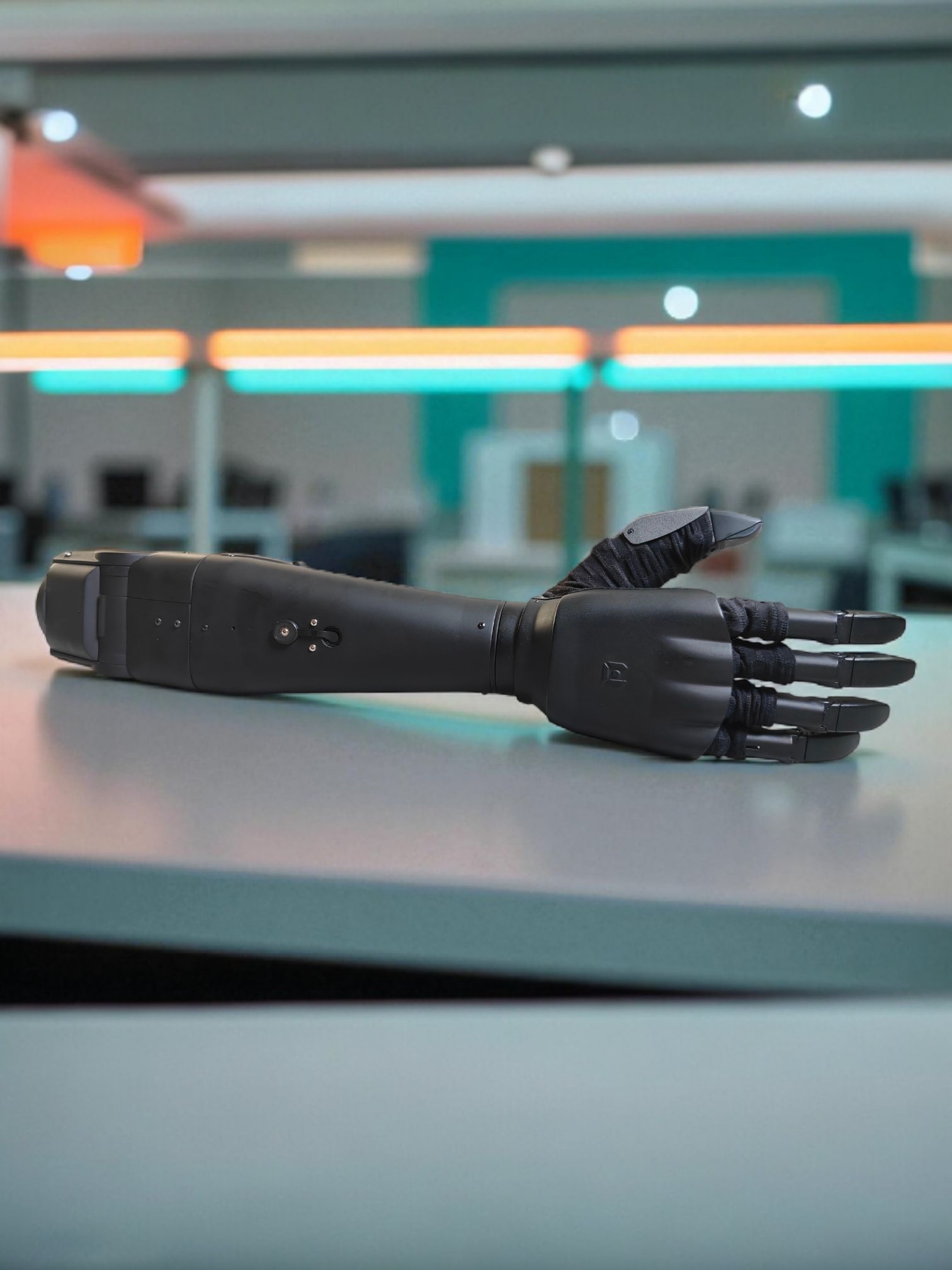
Modern bionic arms have changed the way people with limb loss interact with the world. At the heart of this transformation lies a powerful technology called myoelectric control—a system that allows muscles to communicate directly with machines.
Instead of relying on cables or body-powered mechanics, myoelectric prosthetics use the body’s own electrical signals to control movement. This article explains how myoelectric control works, why it matters, and how innovators like Bendita Bionics and Angel Hand are advancing this technology.
Myoelectric control is a method of operating prosthetic devices using electrical signals generated by muscle contractions. Every time you move a muscle, your nervous system sends electrical impulses to that muscle. These signals can be detected, amplified, and translated into movement by a bionic arm.
In simple terms:
You think → muscles activate → sensors detect signals → bionic arm moves
This makes myoelectric prosthetics far more intuitive than traditional artificial limbs.
When you attempt to move your hand—even if the hand is no longer present—the muscles in your residual limb still receive signals from the brain. These signals are known as electromyographic (EMG) signals.
Key characteristics of EMG signals:
Very small (measured in microvolts)
Unique patterns for different movements
Repeatable with training
Myoelectric sensors are designed to capture these signals accurately and consistently.
Most modern bionic arms use surface electrodes placed inside the prosthetic socket. These electrodes:
Sit against the skin
Detect muscle activity without surgery
Send data to the control system
Both Angel Hand and Bendita Bionics use high-quality surface electrode systems to ensure stable and reliable signal detection during daily use.
Raw muscle signals are weak and noisy. Before they can be used, the system:
Amplifies the signal
Filters out electrical noise
Normalizes variations caused by sweat, fatigue, or movement
This step is critical for accurate control.
Modern myoelectric systems don’t just look at signal strength—they analyze patterns. Each movement (open hand, pinch, grip) produces a unique signal pattern.
AI-driven pattern recognition allows the system to:
Identify intended movements
Reduce accidental activations
Enable multiple grip modes
This is especially important for multi-articulated bionic hands.
Advanced myoelectric control supports proportional movement, meaning:
Stronger muscle contraction = stronger grip
Lighter contraction = gentler movement
This allows users to hold delicate objects like paper or glass without damage.
In multi-articulated hands, each finger has its own motor. Without intelligent control, this would be overwhelming for the user.
Myoelectric control systems simplify this by:
Mapping muscle signals to grip patterns
Automatically coordinating finger movement
Switching modes smoothly and intuitively
Angel Hand is well known for precise finger articulation made possible through refined myoelectric signal processing.
Bendita Bionics focuses on building lightweight, user-friendly bionic arms that work reliably in everyday conditions—not just in controlled environments.
Their approach to myoelectric control emphasizes:
Consistent performance despite sweat and movement
Reduced training time for users
Affordable access to advanced prosthetic technology
Adaptation to real-world usage patterns
By working closely with clinicians and users, Bendita Bionics ensures that myoelectric control translates into comfort, confidence, and independence.
Angel Hand has established a strong reputation for:
Stable signal interpretation
Predictable grip control
Smooth and refined hand movement
Their systems prioritize reliability, making them suitable for users who require consistent performance throughout the day.
Compared to traditional prosthetics, myoelectric systems offer:
More natural and intuitive control
Improved dexterity
Better cosmetic appearance
Reduced physical strain
Greater independence in daily activities
For many users, myoelectric control feels less like operating a machine and more like regaining a part of themselves.
Despite its advantages, myoelectric control faces challenges such as:
Signal variability due to fatigue
Learning curve for new users
Limited sensory feedback (touch perception)
Ongoing research is addressing these through:
AI-assisted signal adaptation
Improved electrode materials
Haptic feedback systems
The future of myoelectric control may include:
Faster AI-based intent recognition
Sensory feedback that mimics touch
Brain–muscle hybrid control systems
More affordable and accessible designs
Companies like Bendita Bionics and Angel Hand are playing key roles in shaping this future by combining engineering excellence with user-centered design.
Myoelectric control is the bridge that allows muscles to talk to machines. By translating human intent into precise movement, it has revolutionized bionic arms and restored independence to millions worldwide.
As technology continues to evolve, myoelectric control will become even more intuitive, powerful, and accessible—bringing us closer to prosthetics that truly feel like part of the human body.
Click to Close